.svg)
Testing a Budgeting Intervention to Address Seasonal Hunger
Project Description
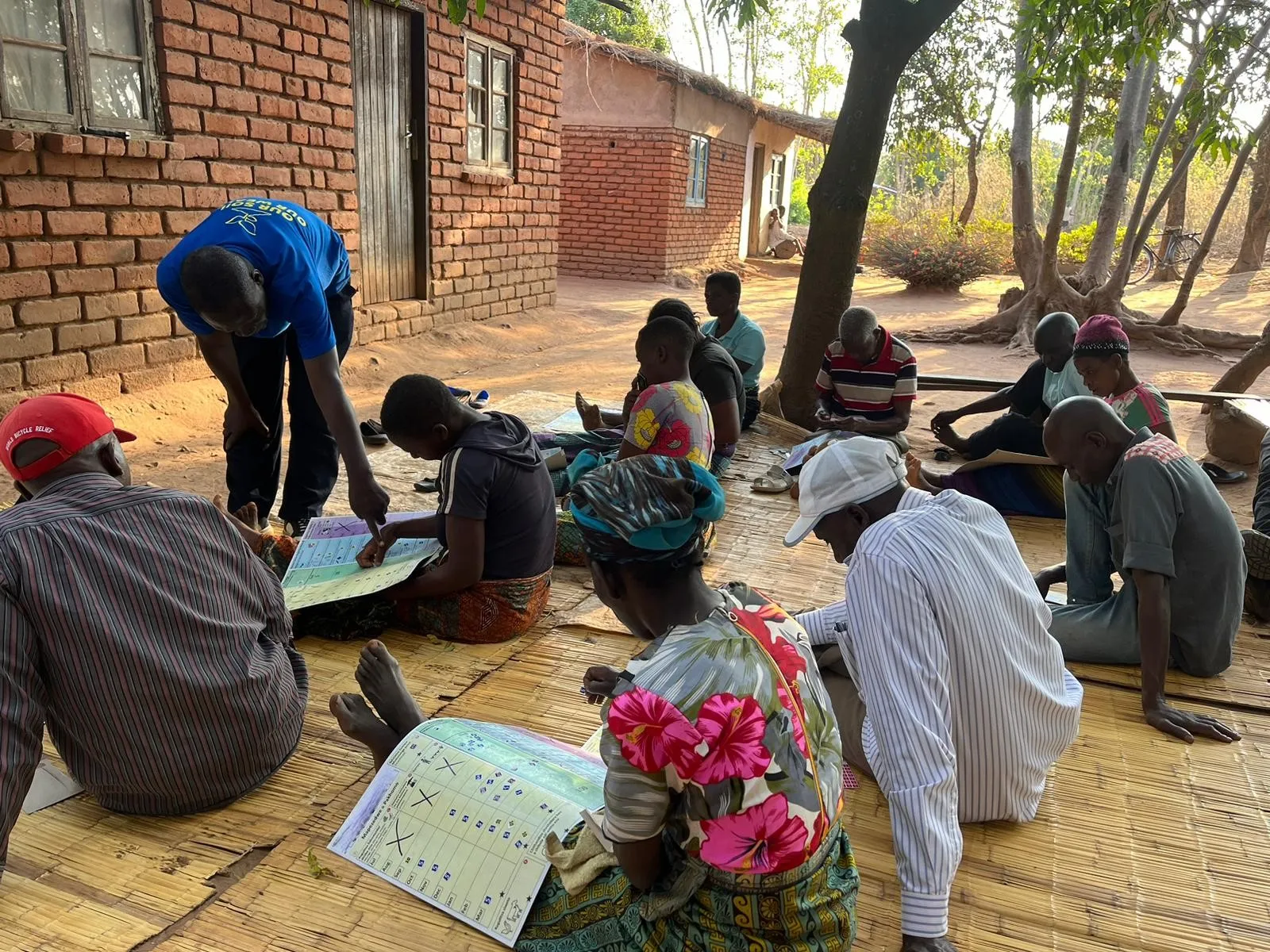
In Malawi, a majority of rural households experience seasonal hunger, which can negatively affect health and nutrition for both children and adults. Researchers at the Center for Effective Global Action (CEGA) at the University of California, Berkeley developed a low-cost behavioral intervention designed to help smallholder farmers use a structured planning process to allocate their annual income to last until the next harvest. CEGA's intervention consists of training farmers to use simple planning boards divided into various income and expense categories, helping participants to generate realistic spending estimates and budget their harvest income to smooth consumption throughout the year. Farmers keep the planning boards to remind them of their plans and receive physical labels for their bags of maize that reflect their spending plan for the upcoming year. A RCT in Zambia in 2020-2024 found that participating households entered the hungry season with 20 percent more savings (approximately one additional month of savings). CEGA has since adapted its approach to the Malawian context, considering farmers' diverse income streams and improving cost-effectiveness by training groups of farmers rather than individuals. With support from the DIV Fund and the WAM Foundation, CEGA will partner with One Acre Fund (1AF) to facilitate the group planning exercises while CEGA researchers evaluate the overall approach using a randomized controlled trial. The evaluation will generate key evidence on the near-term and persistent impacts of the approach, as implemented in a new context and at a larger scale, on households' savings, consumption, and expenditures. If it shows positive impacts, 1AF may integrate it into its programming across Africa, which reaches approximately four million households.
Other Projects
Explore more projects from the DIV Fund
.webp)